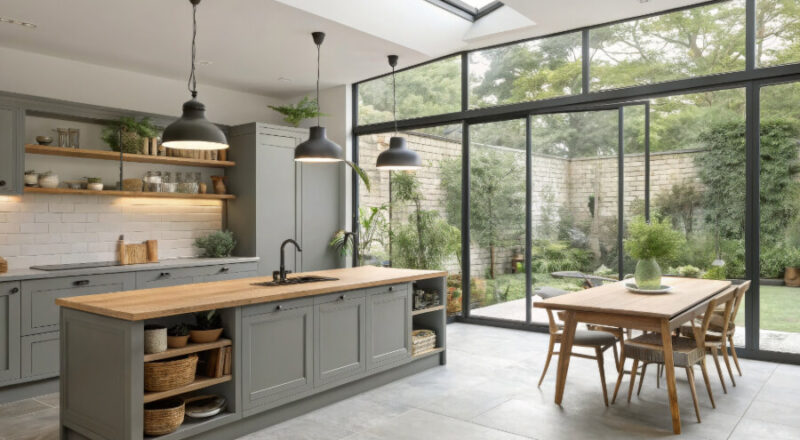
The heart of the modern British home has undergone a dramatic transformation over the past two decades. Where once stood a series of separate, compartmentalised rooms—each with its own distinct purpose—today’s homeowners increasingly gravitate towards fluid, interconnected spaces that blur the boundaries between cooking, dining, and living. This shift represents more than mere architectural fashion; it reflects our evolving relationship with domestic life itself, where the kitchen idea has transcended its traditional role as a purely functional workspace to become the social nucleus of family gatherings and entertaining.
Yet this seemingly straightforward design choice—removing walls to create one expansive, unified space—carries far greater complexity than first meets the eye. According to Realtor.com, homes with open-concept floor plans appreciate 7.4% a year, making them increasingly attractive to both homeowners and property investors. However, the decision to embrace open-concept living requires careful consideration of numerous factors that extend well beyond aesthetic appeal, touching on everything from family dynamics and lifestyle preferences to practical concerns about noise, cooking odours, and privacy.
The Allure of Seamless Living
The fundamental appeal of open-concept kitchens lies in their ability to transform the very nature of how families interact within their homes. The absence of walls facilitates easier conversations and interactions, making it perfect for those who love to entertain guests or keep an eye on the kids while cooking. This architectural approach dismantles the traditional hierarchy of domestic spaces, where the cook was often isolated from the family’s social activities, relegated to a separate room whilst others gathered elsewhere.
The psychological impact of this transformation cannot be understated. Modern families increasingly value connectivity and shared experiences, particularly in an era where busy schedules often fragment family time. An open-concept kitchen enables parents to prepare meals whilst simultaneously supervising homework, engaging in conversation, or simply maintaining visual contact with children playing in adjacent areas. According to Houzz’s 2025 U.S. Kitchen Trends Study, homeowners everywhere are saying goodbye to formal dining spaces in favor of larger, more multifunctional kitchens, reflecting this broader cultural shift towards casual, integrated living.
Natural Light and Spatial Dynamics
Perhaps nowhere is the transformative power of open-concept design more immediately apparent than in its relationship with natural light and perceived space. With fewer barriers, sunlight freely permeates the space, illuminating your cooking space and beyond, thereby creating a warmer and more welcoming atmosphere. This enhanced light distribution addresses one of the most common complaints about traditional kitchen layouts—the feeling of being confined to a dimly lit workspace whilst the rest of the home enjoys abundant natural illumination.
The spatial benefits extend beyond mere light distribution to encompass the fundamental psychology of space perception. Removing physical barriers between rooms creates what designers call “borrowed space”—areas that visually expand beyond their actual square footage. Open-concept designs are synonymous with modern homes, offering an illusion of more square footage, even in smaller spaces. This effect proves particularly valuable in Britain’s often compact housing stock, where maximising the sense of space becomes a crucial design consideration. The continuous sightlines and uninterrupted flow patterns characteristic of open-concept layouts can make even modest homes feel considerably more expansive and breathable.
The Entertainment Factor
The social advantages of open-concept kitchens become most pronounced when entertaining guests. Traditional kitchen layouts often relegated the host to isolation during food preparation, missing crucial social interactions whilst tending to cooking duties. Open-concept designs eliminate this artificial separation, enabling hosts to remain actively engaged with their guests throughout the entire entertaining process.
This layout offers the freedom to customize and utilize the living area according to changing needs, whether it’s hosting a large gathering or creating a cozy spot for family dinners. The flexibility inherent in open-concept spaces proves particularly valuable for households that regularly entertain, as furniture can be rearranged to accommodate different group sizes and activities. Kitchen islands, in particular, have evolved to serve multiple functions beyond mere food preparation, often incorporating seating areas that encourage casual interaction and create natural gathering points.
The Challenge of Cooking Odours
However, the elimination of physical barriers that makes open-concept kitchens so socially appealing also introduces significant practical challenges, chief among them the management of cooking odours. Cooking odors can quickly spread throughout the entire house, making it smell like your kitchen even if you’re not in the room. This issue proves particularly problematic for families who regularly prepare aromatic dishes featuring strong ingredients such as garlic, fish, spices, or fried foods.
The solution to odour management in open-concept kitchens requires a multi-faceted approach centred on superior ventilation systems. Having a range hood with a minimum of 600 CFM is ideal, or installing an auxiliary ceiling vent to remove indoor air to the outside. However, effective ventilation extends beyond simply installing powerful extraction equipment. We have a good quality, powerful, quiet expensive extractor fan, as one homeowner notes, emphasising that quality and noise levels matter as much as extraction power. Additionally, boiling a half cup of vinegar with a cup of water in a small saucepan if you’re going to be cooking with potent ingredients can help neutralise odours during the cooking process itself.
Noise Considerations and Acoustic Management
Closely related to odour concerns is the issue of noise management in open-concept spaces. I found noise more than an issue than smells, reports one homeowner who has lived with both open and closed kitchen layouts. The acoustic challenges of open-concept kitchens encompass not only cooking-related sounds—the sizzle of pans, the hum of appliances, the clatter of utensils—but also the broader issue of sound travel throughout interconnected living spaces.
There’s no question that restaurants have grown louder over the past few decades. The combination of the sound of the oven, dishwasher, coffee percolator and more with the noise of music and diners conversing with each other makes the concept of an open kitchen a little hard to accept from an operational standpoint. This restaurant industry observation translates directly to residential settings, where families must balance the social benefits of open-concept living against the acoustic challenges it presents. Modern appliance manufacturers have responded to these concerns by developing quieter operation modes and improved sound insulation, but the fundamental challenge remains: activities in one area of an open-concept space inevitably affect all connected areas.
Privacy and Personal Space
The elimination of physical boundaries that defines open-concept living inevitably raises questions about privacy and personal space within the home. Privacy concerns are a common issue, as the lack of walls can make it difficult to find quiet, secluded areas. This challenge proves particularly acute for families with varying schedules, different entertainment preferences, or household members who work from home and require quiet, focused environments.
Without distinct boundaries, it can be difficult to define specific areas for different activities. This can lead to clutter and a lack of cohesion in the overall design. The absence of walls removes natural organisational boundaries that help maintain order and define functional zones within the home. Families considering open-concept designs must thoughtfully plan storage solutions and establish clear protocols for maintaining visual order throughout the interconnected space. The owner needs to be vigilant that clutter doesn’t get out of hand. This also means being tidy because no one wants to look at a big pile of dirty pots, prep tools, unused ingredients, etc. during a meal.
Financial Implications and Property Value
The financial considerations surrounding open-concept kitchen renovations extend well beyond initial construction costs to encompass long-term property value and market appeal. Homes with open-concept kitchens often stand out in the real estate market, making them more attractive to potential buyers, providing a compelling argument for homeowners considering such renovations as investment strategies rather than purely lifestyle choices.
However, the financial equation proves more complex than simple appreciation rates might suggest. The median spend on major kitchen remodels went up—it was $55,000 between mid-2022 and mid-2023, an increase of 22% year over year and an increase of nearly 60% since mid-2020. These substantial costs must be weighed against potential returns, market conditions, and individual financial circumstances. Moreover, the modern and spacious feel of an open kitchen can significantly increase the selling price of your home, providing a solid return on investment, though this benefit depends heavily on local market conditions and the quality of execution.
The decision to embrace an open-concept kitchen ultimately hinges on a careful evaluation of personal lifestyle, family dynamics, and practical considerations that extend far beyond aesthetic preferences. The debate between open concept and more traditional, zoned kitchen layouts continues in 2025, with homeowners and designers seeking to find the perfect balance between connectivity and functionality. The growing popularity of “broken plan” layouts—which maintain spatial openness whilst incorporating subtle divisions—suggests that the future may lie not in absolute openness or complete separation, but in thoughtful hybrid approaches that capture the benefits of both design philosophies.
For families who prioritise social interaction, frequent entertaining, and the integration of cooking activities with daily life, open-concept kitchens offer undeniable advantages that can transform the domestic experience. However, these benefits come with equally significant challenges related to odour management, noise control, privacy concerns, and maintenance requirements that demand serious consideration. The most successful open-concept kitchen projects result from honest assessments of household needs, realistic acknowledgment of lifestyle patterns, and comprehensive planning that addresses both the opportunities and challenges inherent in this popular design approach. Ultimately, the question is not whether open-concept kitchens are objectively superior, but whether they align with your family’s specific needs, preferences, and vision for home life.